Showing posts with label movie review. Show all posts

Tuesday, February 27, 2007

Labyrinth Of Fiction And Reality

This spanish movie managed to gain lots of attention and some well-deserved Oscar nominations. Indeed, its climb in imdb's top movie list is very impressive. Given my attraction to fantasy- related movies, I naturally checked it out. The pleasant surprise was that "Pan's Labyrinth" uses its fantasy elements in a very original way. Fantasy movies usually have very realistic messages or very strong allegories. In this case, we have a fantasy that is only a by-product of a very realistic story and empty of most meaning on its own. This is something that one can be very critical of, since the movie's main attraction are the special effects of its fantasy aspect. However, meaning and imagery are not qualities that are required to be present in a uniform way in order for a movie to achieve its purpose.
To be more specific, "Pan's Labyrinth" deals with a young girl's fascination with fairytales and the way this fascination is put to use when her life in fascism-plagued Spain takes an unpleasant turn. The realistic part of the movie is very reminiscent of some greek movies with similar theme. The portrayal of the dictators' evil and the rebels' heroics is very simple and direct, but also very effective. The fantasy part of the movie is there just to amaze the viewer with beautiful and/or disturbing images. It is very effective in this as well. The lack of a deeper message is no drawback. The sadness of the story, coupled with the original use of fantasy elements more than make up for it. Even though I hesitate to call it a masterpiece, it appears that internet movie-lovers seem to think so. I urge you to decide for yourself.

Friday, January 26, 2007

The Last Days Of The Maya

Mel Gibson hasn't been in the public opinion's favor lately. It's understandable considering his conduct. Having stupid beliefs and being famous is a bad combination (see also : Tom Cruise).
Of course, all that is completely irrelevant to Gibson's skills as a director. "Apocalypto" is one of those movies whose visual character render their creator a respectable artist. The plot is about a young man of a Mayan tribe who flees his sacrifice to save his family. The simplicity of the plot, however, is an excuse for a series of excellent action scenes, beautiful imagery and the skillful portrayal of a civilization that is rarely featured on the big screen. It is also an excuse for us to ponder what are the greatest motivators of a human being, no matter the time or the circumstances.
I am overlooking the fact that Gibson's most succesful movies have been, in part, violent. Violence can serve a purpose in art, and it's the purpose we should criticize, not violence itself. The purpose of the violence in "The Passion Of The Christ" was probably just a guilt trip for the believers. In "Apocalypto", if I am to interpret one of the taglines of the movie, the violence is meant to be offered as a reason for Mayan corruption, and eventual downfall. I find this slightly hypocritical, considering that the violence of the Spanish (seen arriving at the end of the movie) to whom the Maya succumbed, isn't really morally superior.
But that's a bit of ranting on my part. "Apocalypto" is a rare movie that can justify your visit to a multiplex. Not many movies do lately.

Sunday, April 30, 2006

Welcome To Silent Hell


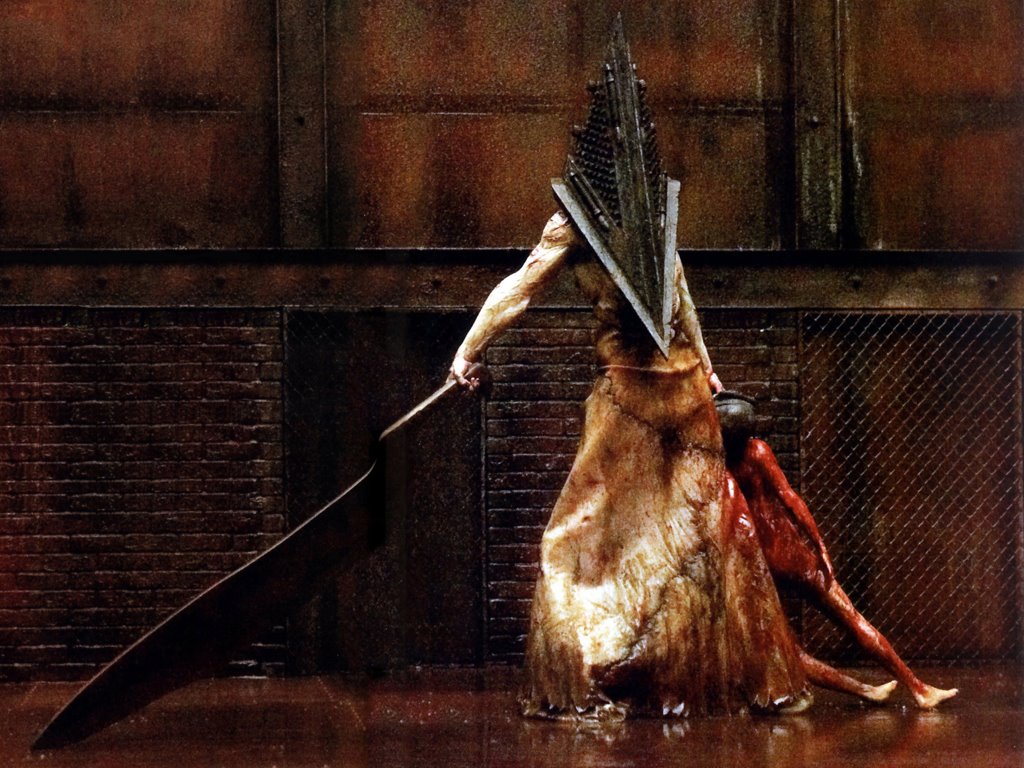
Movies that are inspired by video games are rarely worth it. The story usually required to make a good movie is beyond the scope of a video game, even a great one. I haven't played the "Silent Hill" game, but the movie manages to evade most hints about video games, at least to unsuspecting viewers. That said, it still is plagued by some of the stereotypical flaws of such movies : mediocre acting, unexplained plots, shallow emotions. Even so, this is a horror film and it is quite succesful at conveying horror. The transition from the silent but creepy deserted town into a screaming, dark hell is impressive. The gruesome, disfigured not-quite-human creatures are horrible enough to make you indifferent to their unexplained origin, and that can also be said about the demonic presence of the Pyramid Head pictured above. A most disturbing character that could have his own horror movie series. The bloody climax of the movie is a very violent one but it is so entertaining I think it could be longer.
In the end, Silent Hill is quite entertaining if you are not looking for more than visually stimulating horror scenes. If you enjoyed "The Cell" despite Jennifer Lopez's presence, then you will probably love Silent Hill movie.

Monday, April 17, 2006

Ideas Are Bulletproof

It is usually a compliment to say that something has left you speechless, but it is much less than a compliment for someone who says so about "V For Vendetta". Indeed, the movie's purpose is, more than anything else, to encourage you to speak, no matter what it is you have to say.
In a future Britain, this isn't possible; speaking against the government may get you killed. In a society nurtured with fear and lies, the masked hero simply known as V will try to change the world. The parallels with George Orwell's "1984" are obvious, especially when the Chancellor is played by John Hurt who was the lead in the film with the same name. Even though V is pursuing a very personal vendetta, the "hero" title could not suit him more. Everyone who tries to better society at personal cost should bear it. V may be violent but he is also noble. His portrayal by Hugo Weaving is more reminiscent of the elven authority of Elrond (The Lord Of The Rings) than the cold and self-centered artificial intelligence of Agent Smith (The Matrix). Weaving's performance makes V's mask come alive; you almost see the expressions on it. It'd be no wonder if the terrorist label put on the romantic and brave bringer of justice confused some people. But does this really suggest a thin line between terrorism and justice or that our definitions are in serious need of reevaluation? A most important and timely question out of the many raised in the movie.
Evey, played by Natalie Portman, represents the crowd, society, everyone. She must overcome her fears and this cannot happen before she realizes that what she believes in is worth more than her life. V uses deception to achieve this but he claims the freedom of the artist who uses lies to tell the truth. Like Evey, society must overcome its fear and change. There will always be short-sighted people who will think that this movie glorifies terrorism, but how can V's masterplan to remove society's fear be called terrorism when it is the exact opposite? Taking a building to give hope seems like a fair exchange but V, in a beautiful symbolism, leaves the decision to Evey.
There are many more things to be said but I would only like to ask a few questions as food for thought. Is reality at all similar with the movie's universe? If it is, and the authorities perceive its messages as harmless when they are not, what are the mechanisms that render them so? If it's not, why would western democracy's apparent success inspire such a story?
I should note here, as closing line, that the inspiration belongs to Alan Moore and his comic with the same name. I haven't but I plan on reading it soon.